Book Intro
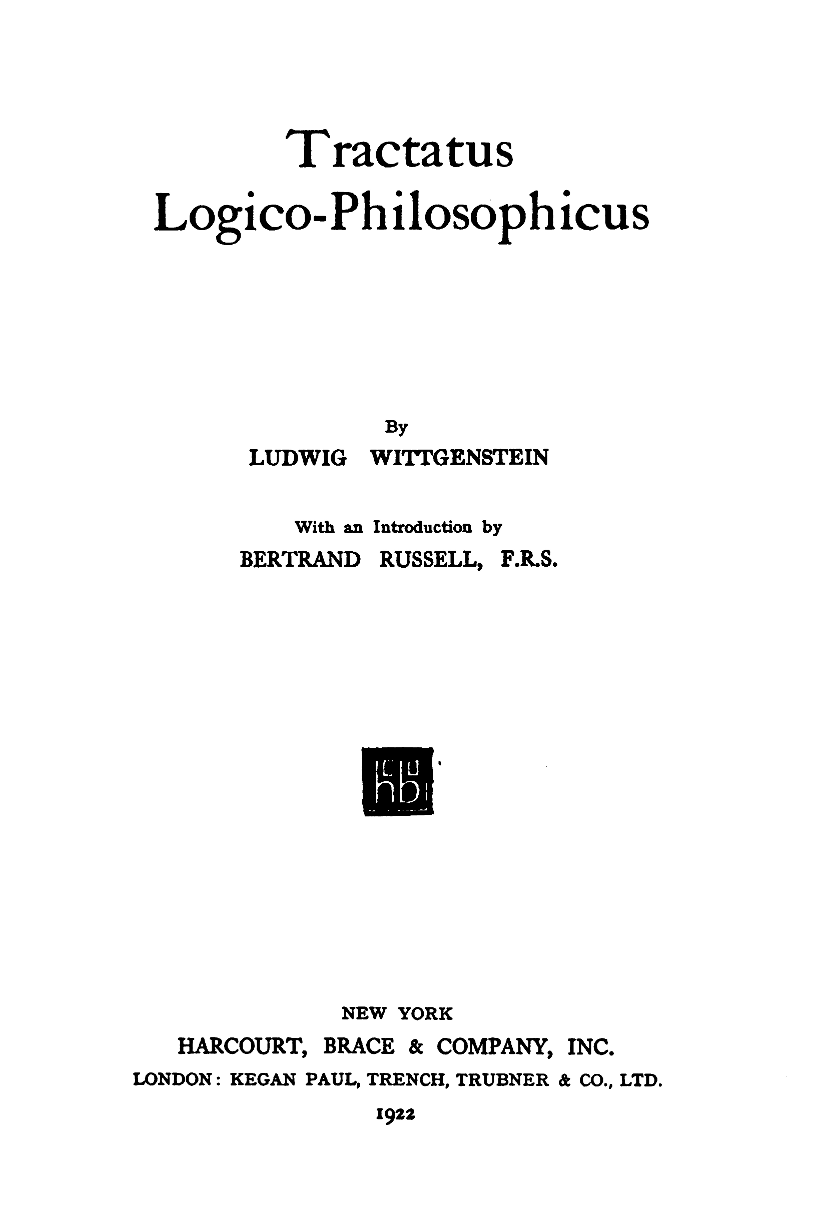
Tractatus Logico-Phiosophicus(Latin for Treatise on Logic and Philosophy) is the only book-length philosophical publication during Ludwig Wittgenstein’s lifetime. This book gives a structural system of the world by propositions of things, properties, situations, events, and even logic. Since the system requires a media or language to build on, this work distinguishes between what can be said and what we cannot.
My AI meets Wittgenstein story
I started to study Wittgenstein in 2015 for my indie AI research. In machine learning, we collect data points and apply a learning algorithm to generate models for future inference. One day, I felt strange about why the descriptions of assumptions, axioms, or inference rules are usually not considered “data points.” Why can we put assumptions, axioms, and inference rules “outside” of propositions or data we analyze? If the descriptions of assumptions, axioms, and inference rules are merely “data points” in the system, a few data points shouldn’t dominantly decide how the resulting model works.
It reflects the following experience we all had: we see the description of deductive reasoning and think there is only one “correct deductive reasoning”. Isn’t it weird? There can be many or even any way to apply the description of deductive reasoning. Maybe the problem may be between the correspondence between descriptions and reality. Then, how do we build the picture from what we say to those ideal objects like “deductive reasoning”? Without such a study, we could feel there was a certain way to apply deductive reasoning, but it could be an illusion without rational support. As a consequence, maybe we can’t even validate any inference procedure for reasonings on all topics from mathematics to sciences via logic.
Above, I needed a system that could describe any case of the world including logic itself. That is the ultimate system for propositions that picture cases of the world. I consulted Professor Jeu-Jeng Yuannand he recommended Wittgenstein to me. From that time, Wittgenstein gradually becomes the philosophical foundation of our Artificial General Intelligence (AGI) research and development.
The early and the late Wittgenstein
Our main philosophical tool on AGI is the late Wittgenstein and his Philosophical Investigation, which at least the viewpoint of it is completely different from Tractatus. Nevertheless, Tractatuscan be a great preliminary work for any person who is too attached to formal or logical methodology to enter non-structural or at least semi-structural research methodology advocated in Philosophical Investigation. As far as I can see, after understanding the very formal Tractatus, people could really appreciate the existence of Philosophical Investigation– many problems we can’t solve formally but we can still solve them.
My interpretation and notes in future posts
I plan to post more about Tractatusin the future. Hopefully, from the viewpoint of an AI domain worker.