Revision: v0.2.1
What is the essence of Logic? Why can we rely on it at ease?
We have confidence in deductive reasoning. As long as the premises are true, the conclusion must be true. If “All men die” and “Socrates is a man,” then “Socrates dies.”
We usually think the only problem is we can doubt premises and their further premises. Why do all men die? You say: “all creatures die.” Why do creatures die? You say, “Aging is programmed in their genes.” “Why are their genes programmed like this”? You can always continue to question.
To stop endless questions, we rely on assumptions. We assume something to be true. With assumptions, we can have a common basis to reason possible conclusions.
But, haven’t you wondered why assumptions can work? That is, for example, if we assume x is an apple, will it act as an apple in the following reasoning?
That’s the function of assumption! We just assume it to be an apple. Making assumptions is meant to stop questioning. We’re assuming. Its reality doesn’t have to be the case. Let’s make it true first.
So actually, you assume that “making assumptions” can work. We can keep going. Does that mean you assume that “when we assume that making assumptions can work, making assumptions will work”?
Where do you get this logical- must?
The philosopher Wittgenstein is one of the people seriously investigating this.
Tractatus Logico-Philosophicus (TLP)
Tractatus Logico-Philosophicus (Latin for Treatise on Logic and Philosophy) (TLP) is the early work written by Ludwig Wittgenstein. As its name suggests, it’s a work on the whole philosophy, but Logic occupies most of its content. I guess most of the readers won’t be satisfied by his answer. Nevertheless, Wittgenstein did it so strictly, so seriously, and devoted so much life energy. Even though you may dislike the answer, you would probably enjoy this work. It guides us through the journey so we don’t have to consume half of our life digging into the same big question. On top of that, it’s interesting and can bring us mental wonder.
The structure of TLP
TLP has a tree structure of ordered lists. There are seven top-level clauses. Except for the seventh clause, each clause has sub-items you can span them to get details. You’ll see what they look like in the following.
The big system on which logical inferences are applied
Logic is the study of correct reasoning. Reasoning involves explanations. An inference, on the other hand, can be unexplainable. But to simplify, we take them the same in this article.
Logical inference is a process from premises to conclusions. Thus, the first thing is, what are those to be inferences? We make inferences from facts to other facts. The next thing is, what are these facts about?
World and facts
These facts are about some things in the world. So, to investigate logic, you start from the world.
Let’s see the following 3 clauses.
1. The world is all that is the case.
2. What is the case, the fact, is the existence of atomic facts.
2.01 An atomic fact is a combination of objects (entities, things)
The world consists of facts. Facts can be analyzed into atomic facts. An atomic fact is a combination of objects. This is Logical Atomism, within which we have minimal units of facts you can’t further divide them. A fact consists of objects, in which there is some built-in logic.
Pictorial theory of language
But we don’t know yet what is true. We need something that corresponds to their possibility of being true or false. In TLP, Wittgenstein called it pictures.
2.1 We make to ourselves pictures of facts.
Gradually, we would reach the beginning of the pictorial theory of language. Let’s continue to see how the pictorial theory of language was constructed.
Logical pictures
Here, TLP links thinking and pictures. It says what we think would be pictures of facts.
3. A logical picture of facts is a thought.
But what pictures are logical pictures? Let’s see 2.182
2.182 Every picture is also a logical picture.
This clause says that in every picture, we can see a logical structure. For example, when I say New York City is in New York State, it implies that when you visit New York City, you also visit New York State. This also says what we can think must have some built-in logic. We can’t think illogical thoughts.
The next comes proposition. When we express a thought, we say a perceptible proposition with sense (meaning).
3.1 In proposition, a thought is expressed perceptibly through the senses.
Let me stress the other side. This clause is equivalent to a statement that if a proposition is senseless (meaningless), we can’t think nor express it.
Thought, proposition, and language
4. A thought is a proposition with a sense.
4.001 The totality of propositions is language.
Until now, the pictorial theory of language is well done.
Review: world, fact, picture, thought, proposition, and language
The world is all that is the case.
What is the case, the fact, is the existence of atomic facts.
We make to ourselves pictures of facts.
A logical picture is a thought.
In proposition, a thought is expressed perceptibly through the senses.
The totality of propositions is language.
Wittgenstein popularized the truth table
From the series of constructions and the correspondences from facts, atomic facts, pictures, and thoughts to propositions, we arrive at a point about how to build up propositions from elementary propositions (correspond to possible atomic facts). And, how to make inferences through these propositions.
5. A proposition is a truth-function of elementary propositions. (An elementary proposition is a truth function of itself.)
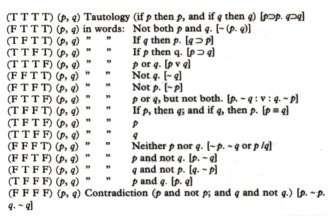
It’s a truth table. TLP is a book from which Wittgenstein is credited as the inventor or at least the one who popularized the truth table. The truth table is common sense in many STEM domains. Nevertheless, many of us probably didn’t know that Wittgenstein is (credited) as the inventor.
Notice that you can either check this table from left to right or from right to left. When you make a logical expression such as “If you visit New York City, you visit New York State,” you claim that “New York City to be in the New York State.” By such expression, when you say something with a logical structure, you say a proposition, a possible state, about the world: a proposition with a sense and a meaning.
Can “making assumptions” work? Tautology??!!
Wittgenstein pointed out the crucial concept of redundancies of propositional logic in TLP. He is the figure who introduced Tautology as a terminology into formal logic. Wittgenstein borrowed from rhetoric, where a Tautologyis a repetitive statement. Unfortunately, according to TLP, when we try to say something about whether “making assumptions can work,” we can only get a Tautology. Why? And what does that mean?
Why can assumptions work? Let’s see the simplest case:
Let p = “it’s raining”
Let q = “there’s a cloud in the sky”
p ⊂ q (if p then q) means “if it’s raining, then there is a cloud in the sky.”
In the case we don’t doubt about the “validity” of “making assumption,” let’s do a very simple inference. If p then q, and p is the case, then q is also the case. (the modus ponens) (here ⋀ as the symbol for AND, ⊂ as the symbol for THEN)
We can write the form as (p ⋀ (p ⊂ q)) ⊂ q. Let’s further write it in the following form
p
p ⊂ q
— — —
q
Now let’s DOUBT it, ask: “(p ⋀ (p ⊂ q)) ⊂ q” -> Can this really work (resulting in q) even if (p ⋀ (p ⊂ q))? This produces such a proposition.
(p ⋀ (p ⊂ q) ⋀ (p ⋀ (p ⊂ q)) ⊂ q)) ) ⊂ q. To make it clear we write
p (1)
p ⊂ q (2)
(p ⋀ (p ⊂ q)) ⊂ q (3)
— — —
q
And we can do that endless times. But in fact, we can stop here. By (1) and (2), we already make (3) as ((1) + (2)) ⊂ q , which says nothing more than (1) + (2) alone. Therefore, no matter how many meta premises we add, we get the same q.
That is the Tautology. Propositions of Logic, including “Why assumptions work,” are tautologies. They are pure symbol manipulations rather than saying some state of the affairs in the world.
It’s now clear, in TLP, that all propositions about logic, all thoughts about logic itself, are tautologies. They say nothing about the world. They are nonsense. Meaningless.
Why logic can work is now beyond the language and what we can clearly think.
What can be shown cannot be said (4.1212)
What cannot be formulated in sayable (sensical) propositions can only be shown. Logic itself is included.
6.522 They make themselves manifest. They are what is mystical.
I’m uncertain if It’s a belief in TLP or if it was taken as a mystical truth.
4.112 ……philosophy is not a theory but an activity……
We can’t clearly say it. We can’t prove it or disprove it. But the logical- mustwould manifest itself throughout our activity of exploring language, propositions, thoughts, facts, and the world.